



Dataset_bak
CAMASA: The Definitive Dataset for Studying Trajectories in Real Urban Environments
From theory to practice: analyzing the actual behavior of autonomous vehicles with authentic cooperative data.
The study of trajectories in complex urban environments is the central challenge for the development of safe autonomous vehicles. However, traditional datasets based on the fusion of on-board sensors (lidar, cameras) have inherent limitations: a narrow field of view and frequent occlusions that obscure crucial parts of the scene. Furthermore, synthetic datasets often fail to faithfully replicate the communication dynamics and specific artifacts of the real world.
CAMASA solves these critical issues by offering a unique resource for research and analysis: a large-scale infrastructure-based dataset derived from Cooperative Awareness Messages (CAMs) and Decentralized Environmental Notification Messages (DENMs).
Why CAMASA is essential for research
CAMASA, located within the Modena Automotive Smart Area (MASA), allows trajectories to be studied in real operating conditions, overcoming the constraints imposed by direct visibility.
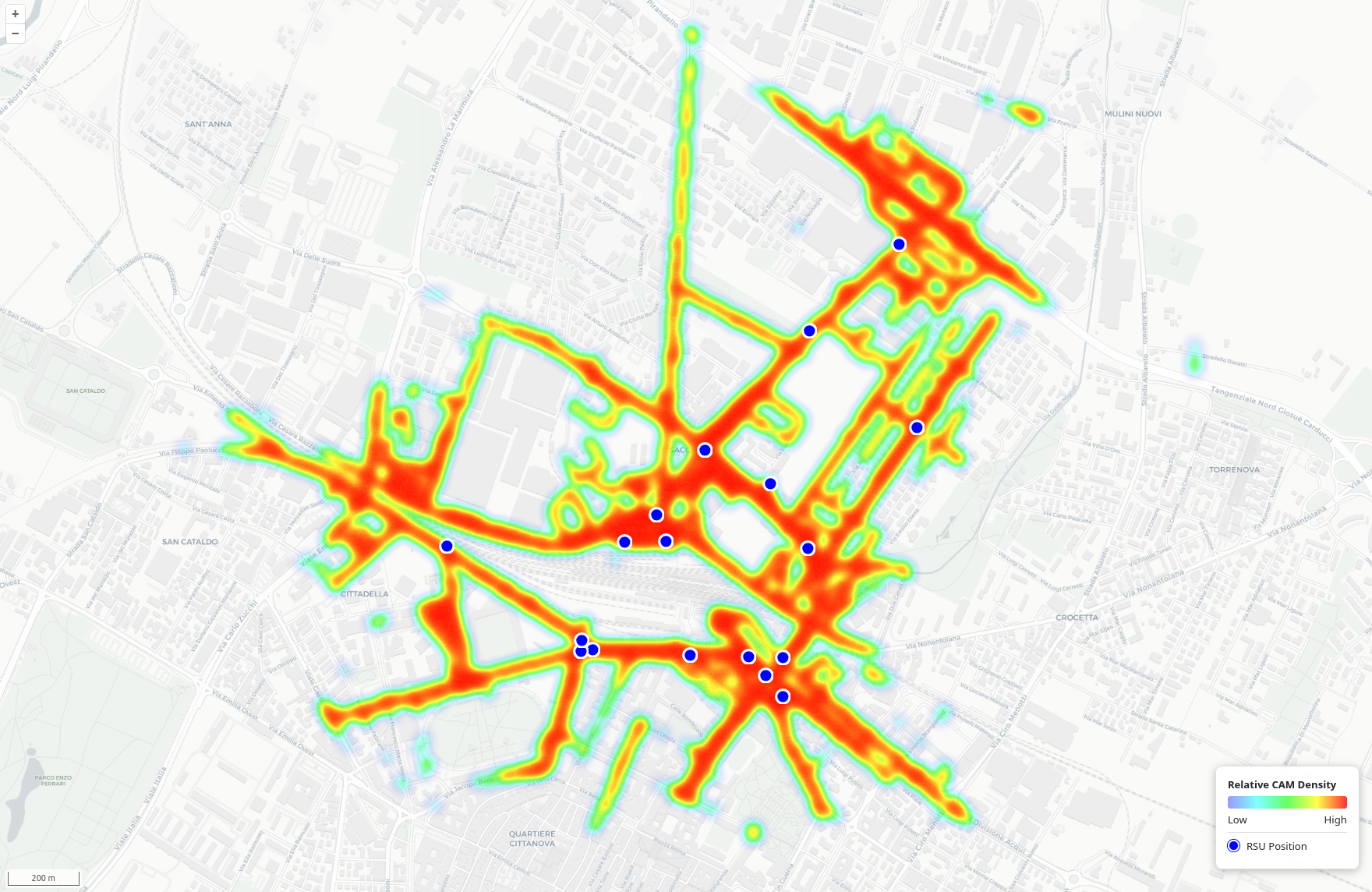
Map of CAM density in MASA.
- Operational Authenticity: Data comes from real production vehicles, captured in authentic, unsimulated urban traffic conditions.
- Unprecedented Scale: The dataset comprises approximately 50 million CAMs and 2 million DENMs, providing robust statistical coverage for meaningful analysis.
- Temporal Continuity: Continuous acquisition over several months allows for the study of the evolution of interactions between vehicles and infrastructure (V2V and V2I) over the long term.
- Overcoming Occlusions: Thanks to the cooperative nature of the data (ETSI ITS), it is possible to reconstruct and analyze the entire scene, even when the physical sensors on board cannot see an object or vehicle.
Preprocessing pipeline and data preparation
To make this raw data immediately usable for research, we implemented a rigorous preprocessing pipeline:
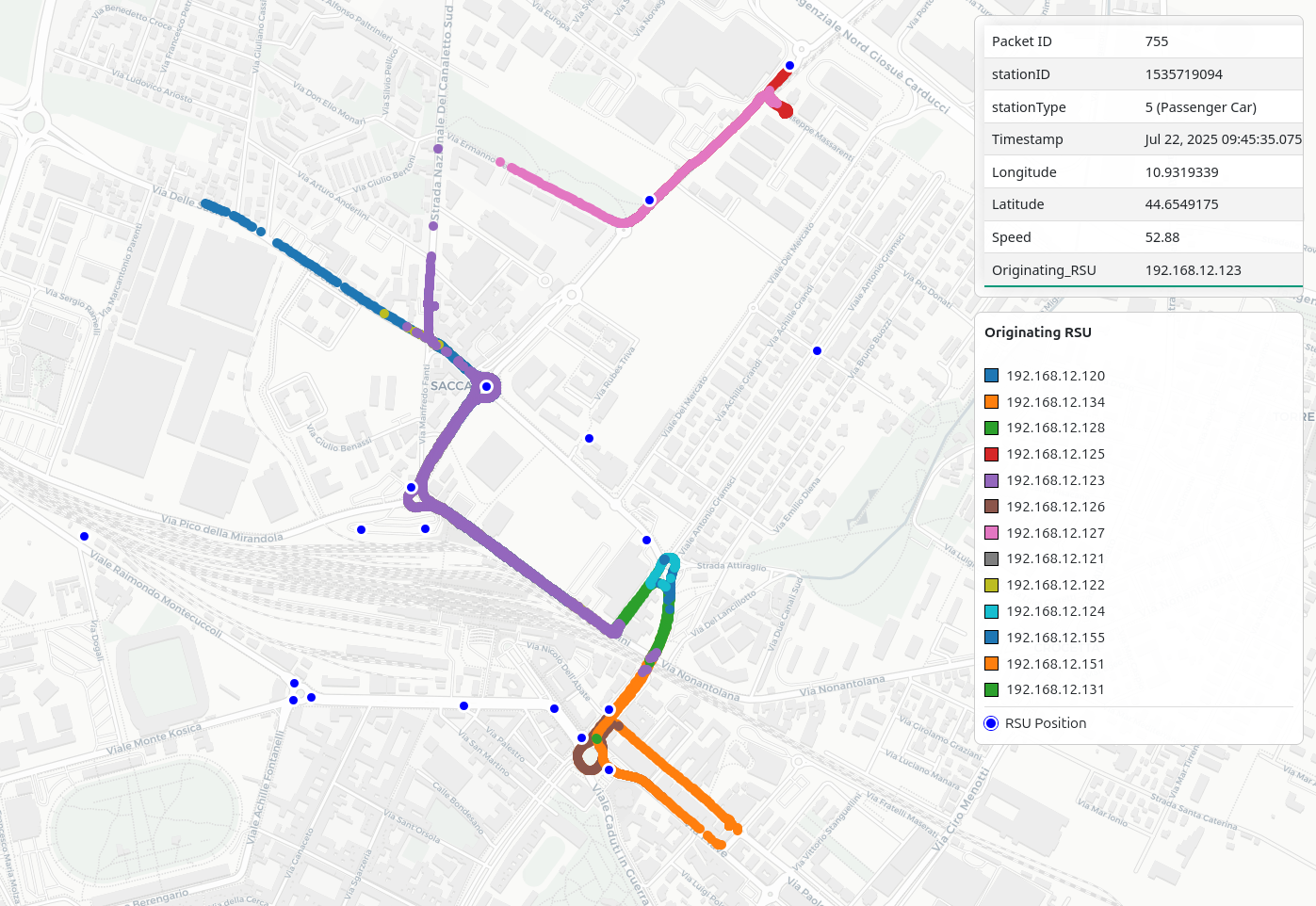
Tracking a vehicle within the coverage area.
- Merging and continuous tracking: We have developed an advanced algorithm that allows vehicles to be tracked over time, preserving their identity even when identifiers (IDs) are dynamically changed to protect privacy.
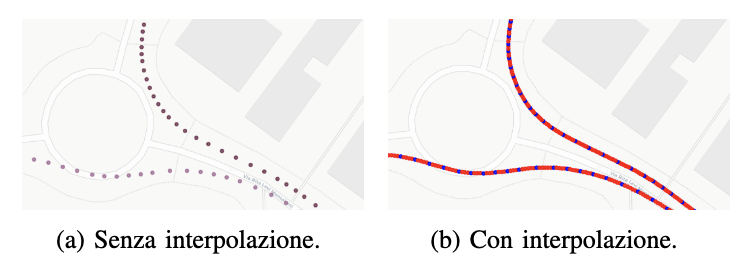
- Highly accurate structured trajectories: the result is a clean, structured data set with a sampling frequency of 10 Hz, optimized for statistical analysis and simulation.
Applications in Research
CAMASA is designed to support advanced studies on:
- Interaction Dynamics: Analysis of how vehicles react to ITS messages (e.g., hazard warnings, turn intention signals) in real-world scenarios.
- Algorithm Validation: Testing prediction or planning models in scenarios that include objects not visible to traditional sensors.
- Behavior in Critical Scenarios: Study of high-risk situations (complex intersections, pedestrian areas) where traditional sensory perception is not sufficient.
CAMASA is a fundamental resource for anyone who wants to understand, analyze, and improve the behavior of autonomous vehicles within an intelligent transport ecosystem.